Insights on German and American culture, things to do in Germany, and the daily life of a 24 year old guy bee-bopping around in Germany for a year with the CBYX
Showing posts with label Culture. Show all posts

04 June 2012

der Legostein

I was a weird kid when I was younger. I nourished myself almost solely with coca-cola and cake frosting, I refused to wear jeans as I was convinced they were made of metal, at the age of 6 I made napalm, and for a good two years of my childhood, my mother had resigned herself to the idea of having an autistic son. She (tentatively) was later proven wrong. Despite my...erm...idiosyncrasies? one part of my childhood was very normal. I loved to play with Legos. I still have a giant box of them in my room and my various Lego spaceships completely with Lego crew are still docked at my Lego space station.

About three weeks ago, I went to visit my very good friend David in Ulm. The goal was that I would meet his family, throw paper airplanes from the highest church tower in the world, and generally make Ulm a little insecure. We did all that of course, but then David dropped a little surprise in my lap. It turns out that Legoland Deutschland is only a hop, skip, and a jump from Ulm. My tail began to wag at the first mention of Legoland, and I got this dopey grin that I couldn't get ride of when I found out that he and I were going to visit it.
The church tower in Ulm. One of my paper airplanes reached the Danube...another one reached the police station.
See, I've always wanted to visit Legoland. The original one is in Denmark, but it's just slightly to the East of the Middle of Nowhere, Denmark, so a trip there was infeasible, and I had all but given up on the dream. I knew there was a Legoland in Germany, but I had forgotten about that one since I'd been living in northern Germany.

Legoland was awesome. I probably would have gotten a very little bit more out of it had I been an actual child, but that would only have been because I could have ridden more rides. I was beside myself with enjoyment as it was though. There are a couple of roller coasters, but since the median age of Legloand patrons is somewhere between 7 and 11, the coasters aren't too scary. The first thing we did was get on a roller coaster, which also doubled as a haunted house type thing. We all got high-fives from the roller coaster operater as we passed by. My guess is that I wasn't the first conspicuously old person to ride the coaster. Afterwards we hit up another ride themed around “Ninjago, Masters of Spinjitzu.” I have no idea what spinjitzu is, but somehow it lends itself to a bucking carousel ride that resembles a tie fighter. The seats also had wings that you could steer. This gave you just enough rope to hang yourself, so to speak. If you tilted the wings just right, you could make your experience significantly more terrifying than your neighbors'. There was another ride that was some sort of robot arm that tossed you around like a rag doll, I cut in front of easy four 2nd graders to get the best spot.

The park also has a movie theater, which was kinda lame. Go figure. The show factory was pretty cool to see, though. Ohh wait I just remembered something about that damned factory! Ok, so the tours are in groups and are all started with a short film about Legos. We waited in line, during this wait a child and I played around by jumping back and fourth with one another. Then the doors opened, and our comeradery dissolved as I basically palmed him and two other kids into the pavement to be the first one inside. The door man was handing out souvenir Lego bricks and I stood there expectantly awaiting my Lego brick. The man looked at me and said in a dismissive tone that only the children get the bricks. I thought about arguing but the last thing I wanted was to get thrown out of Legoland over a goddamned Lego brick, so I sighed, conspicuously loud, and went inside. Bullshit. Today's blog title means “Lego brick” by the way.

By far the coolest thing about the park was the miniature world. The imagineers have recreated a handful of cities around the globe in Lego form and the amount of detail is awesome.

This is the Lego version of the Castle Neuschwanstein. To get an idea of the size,  my friend David is standing in the background taking a picture and he is about 6'2". The plants are all real. I managed to corner a gardener in the park and she told me that there are only 20 gardeners who take care of the entire park.

t
This is a Lego version of Römerplatz in Frankfurt. It's not totally accurate, but Lego is an imperfect medium. Oh, and my (other) friend David, who is a Frankfurt tourguide, told me a story about a man in the Frankfurt city hall who would spy on important meetings, and on the real city hall in Frankfurt they have a small statue of him, which the Lego designers recreated!!!!

Berlin in Lego form. This is specifically the Berliner Dom and the TV Tower, which I captured in my own travels to Berlin.

The is the German Parliament. I haven't seen this technically, yet, but I will be seeing it next week. The short (Lego) woman in the snazzy jacket can be no one other than Angela Merkel (a fellow Ossi, I might add)

This little gem was found in the recreation of Schwabenland, I had to photograph it since both my aunt and David's mom are named Sonja.

I liked this mostly because I utterly hate pigeons. The woman's book says "Pigeon recipes"

Oh lord. Ok, so hooking is legal in Germany, and the city of Hamburg (recreated here) is famous for  the Reeperbahn, an area dedicated to quite literally hookers and blow. So the Lego imagineers recreated Hamburg, complete with hookers.

No, this isn't New Orleans. This is Venice. The ships in the model really do float and travel along the canals. David (the first one) noticed that the 'Italian' music playing in the background was utter gibberish.

I am no fan of Munich, but even I have to admit that this recreation of Allianz Arena is pretty baller. The whole thing is about 7 feet across, and glows at night. They had to design a special kind of brick that was translucent in oder to get the proper effect.


03 May 2012

der Kleingarten

Today’s word means “small garden”, specifically the many small gardens that often make up community garden plots in Germany. But 24 year-old men aren’t really the typical demographic for gardeners, so in order to understand why I give a damn about small gardens you will need some biographical background on me.

When I graduated from Drake, withdrawal from school hit me hard. For the past 17 years, I had had some sort of class Monday through Friday and then all of a sudden nothing. Cold Turkey. It was a rough time, but I decided that maybe, as an adult, I should cultivate a hobby or two that didn’t involve school. Day drinking, I later decided, did not count as a hobby. I tooled around with computer programming, cycling, crochet, and lots of other stuff, but none of it was that fulfilling. I managed to hold out about 3 months before I caved in and enrolled myself in a class. I’ve always loved plants, and I decided that the Iowa Master Gardener Program with its 60-some hours of initial coursework would kill two birds with one stone. Namely, I could get back in a classroom and get rid of my shakes, and I could also cultivate an interesting new hobby.
In the master gardener classes, I looked…out of place. The average age of the other master gardeners is somewhere in the high 50’s, and the gender balance is heavily skewed in the feminine direction. Despite this initial awkwardness, I loved it there! Some very very interesting people are master gardeners. It ranged from jovial high school chemistry teachers to no-nonsense FBI field agents, and, though their personalities are varied, they are all welcoming and affable people. I got involved with the committee that built and maintains the gardens at the State Fairgrounds, and before our first meeting, I sort of expected it to basically be an old ladies’ tea circle. When I got to the restaurant, the other gardeners were already there, and the restaurant had run out of beer because of them. Needless to say they are a fun group of people. So, this is where my interest in gardening and consequently in the small gardens of Germany comes from.
OK, so down to business. These gardens I mentioned, they are everywhere. Since most German houses are built close to each other, there isn’t space for a yard. As near as I can tell, there isn’t a German word for “yard” meaning just a space of grass with a garden around a house. “Hof” is close but is more of a courtyard or farmyard. Consequently, many homeowners will lease a small garden space on the outskirts of the city and plant a garden there. They usually aren’t single gardens, but rather several hundred together. These garden clubs are beautiful, and the area around my dorm and work is filled with them.
Most people build a small house on the garden property to hold tools and whatnot, but some of the houses are more luxurious. In this case they function more like a small cabin or a ‘dacha’ (a Russian word that I learned recently and for some reason find really cool). The garden areas are very serene places and the people clearly put a lot of work into the gardens. Some people use them for vegetable growing, but mostly they are just for visual enjoyment.
I don’t know how popular this type of garden is in the rest of Europe, but the conditions that led to them in Germany aren’t unique to Germany, so my guess is that other places would have them too. If you know for sure about this, let me know. I’m curious.


A path through the garden near my job.

This gardener has a garden filled with several thousand tulips.

German "Ordnung" made real.

This is the path I walk to work everyday. It's gotten so much prettier since then.

13 March 2012

der Kaufrausch

I think this post is going to be the first in my newly thought-up “Alltagslebensserie” or Everyday Life Series. Most of my posts are about large events that I attend or trips that I go on, but this sort of overlooks the other 90% of my time here, which is spent doing absolutely normal things, but of course with a German flair. Hmm, maybe that's poor word choice, I usually don't associate the German lifestyle with the word “flair.” Regardless, some everyday parts of my life are clearly different here in comparison to the states. Today, I'm going to talk about potentially my favorite mundane thing to do in Germany: going to the grocery store. Today's title word is that sort of high feeling you get from buying something you really want.

I hate shopping at home, and when I do go shopping I am methodical. Except for a calculator, I shop alone. I have to get “the deal.” This phrase, “the deal,” I picked up from my sort of grandfather. His penny pinching puts me to utter shame, something or other about living through the depression...He also says “the deal” when he can't think of whatever word he's looking for, which can make conversations about finding obscure things for a good price very hard to follow: “I went down to Dillon's, and they had a deal on that there deal, and so I asked the gal at the counter about the deal....” I should say that I love and respect this guy deeply, and I'm not trying to be mean by making fun of him. This man also introduced me to Aldi's in America, or as he likes to call it “that German outfit up behind Walmart.” And Aldi's is the perfect jumping off point for my comparison.

Remember, Germany does't have a lot of space and this is reflected in their “super”markets. I just looked up the county appraiser's information on Walmart in Topeka, and it is about 212,000 ft2 (19,700 m2). That German Outfit behind said Walmart (Aldi's) is about 15,000 ft2 (1,400 m2).
Our beautiful Walmart. I just noticed that the southern two entrances aren't shown in this picture, so it's actually even larger than it is here.
That's more than 14 times smaller, and Aldi's is the exact same size and layout of a typical German supermarket. To make up for this size difference, there are a lot more supermarkets around the city, and generally they have a smaller selection than you find at Walmart. If you want flour, you have one choice. Canned goods, maybe 15 feet of selection on one side of the aisle. Drinks, well you get the idea. This can be sort of frustrating when you need something sort of obscure. We were going to make pasta with a pesto sauce and had to check three different stores to find it. On the upside, because the stores are so small, there is always one within walking distance.
Netto is the closest market to my dorm.
This is the bread, condiment, pasta, seasoning, jelly, coffee, tea, and baking aisle.
Shopping in German (the language) is also very interesting. It makes every trip educational, and it also seems to make me more curious about things. I stroll through the spice aisle (it's really only a 3 foot section) and end up buying some sort of wildly interesting spice and think “oh the things I could cook with this!”, then I get it home and find out it's actually parsley. Another interesting thing about shopping in Germany is that, for some reason, English words and American-themed packaging on products are “hip” and “cool”, but a lot of times they either make no sense at all or are used in a weird context. I'll give a couple of examples. I was at Aldi once, and they were having American Week, so I went and checked out what German grocers think my country boils down to. The American section was marshmallows, Texas-style curry chicken, and a sort of waffle iron device that made muffins instead of waffles, but all of it had stars and stripes and the Statue of Liberty on the outside. The next example is more recent. I was in Rewe looking for Worcestershire sauce (and I actually found it!), but next to that I found several very interesting sauces, and took pictures. Let's pause and enjoy the weirdness:

Reports indicate this sauce is sort of a sweet and sour sauce with a hint of pineapple.
Somehow "hamburger sauce" is not ketchup.  Nearest I can tell, it's similar to mayonnaise, but not mayonnaise...somehow.
This sauce translates as "Gypsy Sauce", which is somehow not offensive to the Gypsies (actually called  Romani) who do live in Europe.
Ok, this one has nothing to do with misused English, but I still giggle at the word "weiner"

The final strange thing about German grocery stores is the thing the causes me the most stress when I'm there: check out. It's god awful. You have to pay for each grocery bag (about 6-15 cents depending on the size), which means that no one actually buys the bags and just tosses all of the goods willy-nilly back into their cart on the other side of the register. You also have to pay a deposit on the cart, just like at American Aldi's. The cashier herself, is typically as similar in appearance and disposition to a toad as a human can be. I made the mistake of asking her how she was doing once (and only once), she frowned at me for about 3 seconds, then said “fine”, and went back to scanning. The longest conversation I ever had with a cashier here is when one had to ask me what sort of fruit I'd bought so he could look up the code; it was a fig, so it's sort of understandable. Then comes my least favorite part, paying. I almost always pay with cash, and euros don't have paper bills until you hit the 5€ level, so I end up with ass loads of coins in my pocket that I need to get rid of. The problem is that doing math in German is really hard for me, since their numbers are backwards. So, when they say the total is 23.47€, they say the equivalent of three-and-twenty euros seven-and-forty cents, so it takes me a second to realize they don't mean 32.74€, which is the order the numbers were said in. This is precious time I don't have with a line of impatient Germans to my left, a scowling toad-faced cashier in front of me, and a chaotic pile of groceries without a sack to my right. It's like running a gauntlet.


Ugh, the shit I go through to get “the deal”

26 February 2012

Kölle Alaaf!

It is a statistical certainty1 that when a person falls asleep on public transportation, the moment they awaken, they assume RIGHT NOW is the time to get off the train/bus/tram. In reality, this is rarely the case. Keep this little bit of knowledge. It'll be useful in a few paragraphs.

Last weekend I went to Cologne for Karneval! If you're unfamiliar, Cologne is in western Germany and is the place people go to celebrate Karneval. Karneval itself is essentially the same thing as Mardi Gras. I say “essentially” because I'm not religious, and I wanna hedge my bets in case there really is a difference. A few of us PPP'lers who are stranded in the GDR2, decided to meet up in Berlin, rent a car, and drive to Karneval. We stayed with another American girl's host family near Düsseldorf, which is close enough to the revelry.

This of course means that we got to drive on the autobahn, which has been on my bucket list since the first time I was in Germany. The car we rented was a stick-shift, but luckily my mom insisted that I at least learn how to drive stick. I won't lie, I was rusty as hell when I started off, but I drove a stretch that was almost all autobahn, so it was only rough until I got on the on ramp. The German autobahn gods must have been watching me, because right as I got on the autobahn, we hit a section that actually does have a speed limit. After about 30 minutes of that garbage, we finally made it to an unrestricted section. I can't properly describe the feeling of piloting a vehicle at 130 miles per hour. Pure speed. (Mom, if you're reading this, 130 was a typo, I mean 75. Yeah, slow, safe, reasonable 75 mph). Another cool thing about Germany is that there is no open container law, which means that we enjoyed our autobahn trip with some nice East German beers in the car. Of course the driver can't drink, but someone has to take one for the team.
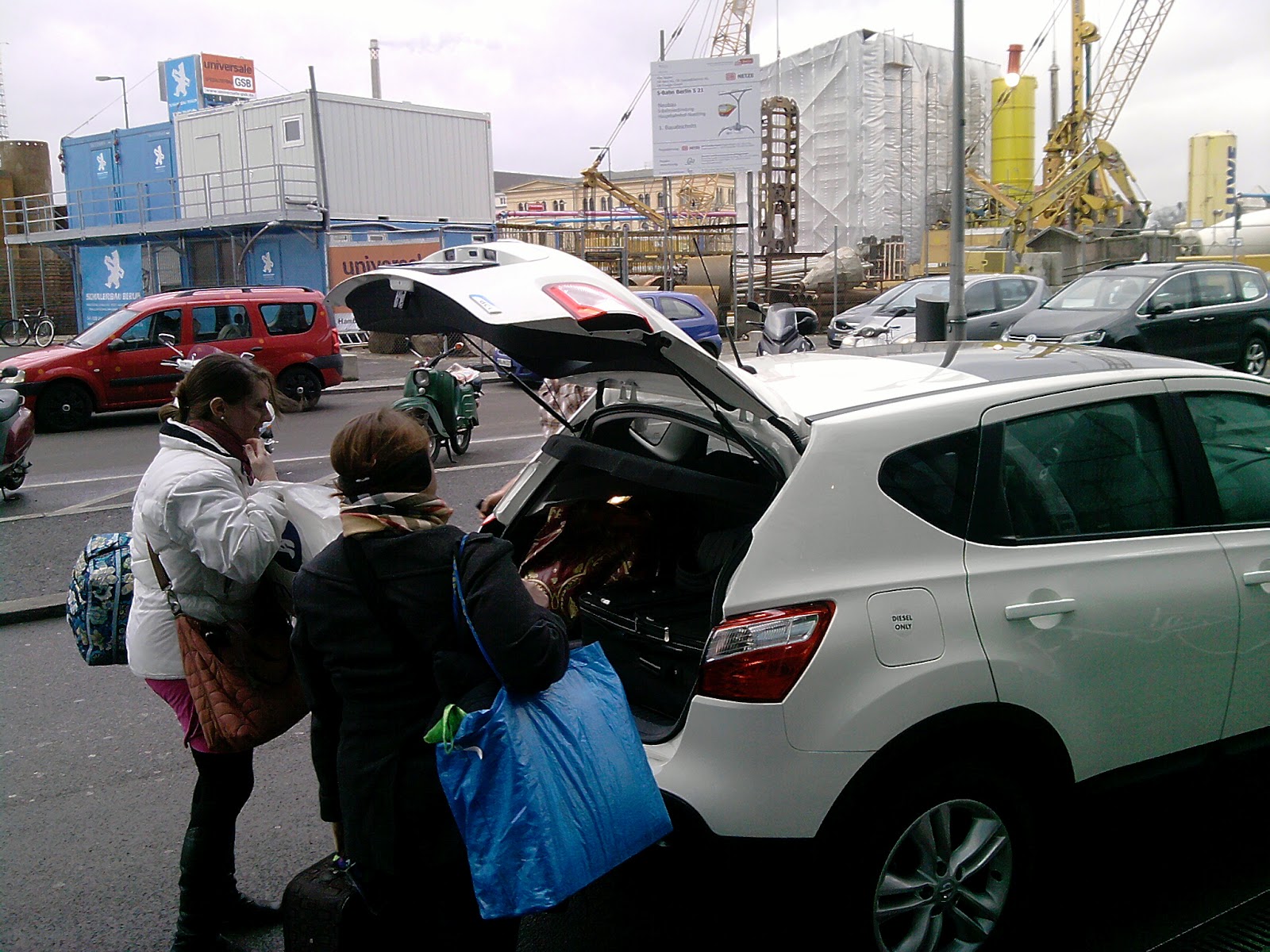
Andrea and Jen packing our car
I do find it odd, that a country that has laws for everything doesn't have a speed limit and allows alcohol consumption (starting at 16) while driving. It took me some thinking, but when I consider that two of Germany's most popular (and politically powerful) industries are beer brewing and automobile manufacture, it makes sense that they would have the political clout to keep away restrictive laws.
I am what you call a "young ambassador"
But eventually, we get to Cologne. A few of us had decided to make a group costume, something which in my opinion never ends up happening in the end. Big plans are made “The Seven Dwarves, but Sexy” or “All the Presidential Candidates” and then in the end everyone shows up as something boring like a cheerleader.. Somehow though this time it actually worked, and damned well too! We all dressed up as characters from Super Mario. I almost ended up going as Princess Peach since Ive got the best legs of the group, but I dressed up as Luigi instead. Of course there was partying and revelry, so I'll skip the stories about that, and jump to my public transit story from the beginning of the post.

On Saturday night, I got separated from my group. In truth, I probably just walked away as I'm prone to do when there is a lull in activity. It's a great way to meet new people in my opinion. Regardless, I get separated from my group. I text to see where they are, and they are heading back to the tiny town we are sleeping in. (Incidentally the path from the train station to our house is a concrete jungle, I'd only walked it one time at 7am on Saturday morning. So it is advantageous to meet up with my friends and navigate it together.) Ok, cool, they're heading back, I will too. I get on the train and promptly fall asleep. When I wake up, that statistical certainty I mentioned earlier comes into play and I get off the train. I get off the train in the middle of nowhere. So I go to the ticket machine and check when the next train comes. The next train comes at 5 after the hour, so I wait. Five after comes....and goes. So I go back to the machine, and I realize that the next train comes at five after 5am, which is 3 hours from now. It's freezing, and I'm still dressed as Luigi. So I curl up in a ball next to the machine and, shivering, I fall into a very light (but not light enough sleep). I am awoken by the sound of the 5:05 train as it leaves the station. “Well fuck,” I said aloud to no one in particular. I'm just gonna call a cab, I can't be that far from home, I think. My phone however is dead, so I go around the neighborhood knocking on doors of houses and businesses alike to find a phone. I eventually find a casino, and the owner asks where I am heading. He then informs me that the ride will probably cost 70€, but the next train comes in an hour. “Well fuck,” I say quietly and mostly to myself. He then offers to let me sleep in the casino for the next hour. This man is a saint. I eventually catch the train back home, and don't make any mistakes this time.
Wario and I.
One of the things I pride myself on is my good memory. It's how I made it through college, it's how I've learned German as quickly as I have, its how I remember funny jokes and turns of phrase. Thanks to this wonderful memory, I was able to successfully navigate my way back to the house from the train station without getting lost. I arrived at 7:30am, again still dressed as Luigi, and have to wake the host parents up to be let in. A total trip time of just over 5 hours.

I crash cold and weary into bed next to Andrea (nothing happened!) and awoke the next morning to play with the children and have a barbeque. All in all a successful weekend of revelry, boozing, costuming, speeding, and “living of the land”.

Oh and before I forget, today's word is a Narrenruf (Fool's Cry) from Cologne, and means Cologne Alive!

1. Not Really.
2. There is no GDR anymore, despite what many old people say.

24 January 2012

There's an Ausbildung for that


The German capacity to impose order rivals that of the Borg. Many people don't notice it because it's such a quietly pervasive part of German society. Spend enough time with Germans or in Germany, though, and you'll start to see it too.

There are little habits like the German love for office supplies. Go to a classroom and nearly everyone has a “Mäppchen“, which is a little pocket that holds their traditional pencils, mechanical pencils, ball-point pens, felt-tip pens, markers, ruler(s) and highlighters. All usually in assorted colors.

Then there are some very well hidden things, like the German legal system. This one took me a long time to notice. I was sitting in a seminar and all of the students seemed to be quoting legal statutes in their presentations, and I thought “Why the hell is there a law for the establishment of recreational small gardens or the amount of fertilizer you can apply to a potato field?” But when I was making my presentation on patent law in the US, all of the laws I found were vaguely worded, and I ended up referencing dozens of court cases in my presentation to get the point across. Then it dawned on me; Germany's legal system isn't based on laws open to interpretation or hair-splitting court cases like the US. They have a statutory legal system, and they codify everything beforehand; there is no uncertainty. The US inherited a common law legal system from Britain, so we have dozens of court cases to determine exactly how a law applies in this and that situation. Also the German legal system doesn't use wishy-washy, imprecise juries. There is just a judge, and if need be, two lay judges, but the lay judges are most certainly not your peers like the jury would be in the US. This bit would be a bonus for me if I immigrated, since I've already been called for jury duty twice in the US!

But my favorite daily example of German order, and, incidentally the topic of this post, is the German apprenticeship system (Ausbildungssystem). The German lower schooling system is a riddle wrapped in a mystery broken into a jigsaw puzzle and cloaked in a conundrum, so I won't even attempt to explain that in this post, but at the end of it all the students have to choose a career, and heaven knows they can't just get a job. They have to first go through one of Germany's 344 governmentally approved Ausbildungen (translated). When I first heard about this system, I though it was fantastic, and admittedly I still kind of do, but for different reasons.

The Ausbildungssystem assures you as the consumer that not just anyone is building your roads, painting your walls, or wiring your house. And in the US we still have apprenticeships for professions like plumber, electrician, barber, carpenter and so forth. It's a good system. I don't want some guy whose “got a thing for electronics” wiring my house, I want a professional. But Germany takes it to a whole new level. If you looked through the list of approved apprenticeships, some of them make perfect sense. They provide the German work force with people trained to do very technical and specific jobs that any industrialized society needs. Some of the jobs though, just seem like the sort of joke a lawyer would hide in a contract to see if anyone actually reads the fine print. There is the Biology Model Maker (this link is in German), the Screed Layer (what the hell is screed?!), the Precision Optician (who is different from the regular Optician...somehow), the Surface Coater, and the list goes on.

The point is, it gets far too specific for my tastes, and some of the jobs seem like they hardly need training. For instance the Ausbilding to become a waiter takes three years! At Red Robin I got a week of training and was thrown to the sharks. My first table was a birthday party of handicapped tweens. I made two of them cry and one boy dislocated another girl's wrist. It was a blood bath. More training would have been nice, but three years is still ridiculous. On the upside, I think the Germans who go through the apprenticeships have more pride in their careers and tend to keep them longer, whereas many Americans take a job and then switch when it no longer suits them.

Now, you might say that this is just an example of out of control bureaucracy; just because the apprenticeships exist doesn't mean the Germans actually hire the people. I beg to differ. Another note on German culture is that Do-It-Yourself does not exist here, not to the extent it does in the US. When I was in language school in Radolfzell, my host mom's son had his birthday party at our house, and they didn't grill or potluck; their hired a butcher. I've been volunteering at a library in town. They had to move buildings and instead of taking things apart themselves, they hired a carpenter. A motion-controlled light needed to be installed, they hired an electrician. My bathroom ceiling molded over, they hired a painter and a sheetrocker.

It's not that the Germans are lazy or incapable, not at all. It's just that the Germans want things done right, and they value dependability. I guarantee, if that motion-controlled light stops working, the electrician will be there to fix it the next day. And the carpenter that was hired for the move was, incidentally, the one who built all of the fixtures in the first place 10 years ago. For me, the sense of fulfillment and triumph I get when I build a futon or a desk is worth it, but for a German it's better to know that that futon or desk is built properly, and that there is someone whose reputation you can depend on standing behind the desk.

I don't think I'll ever be able to understand totally the German need for Ordnung, but I'm getting closer. Though I still wonder what three years of training would be like to become a waiter.

03 January 2012

zu Weihnachten


Holidays are finally over and now I can lie back and coast until Black History Month in February.

Spending Christmas in the dorms here in New Burning Castle (Neubrandenburg) would have been wicked boring, so before the holidays loomed near, I resolved to head back to South Germany. I figured someone would take me in, and worst case scenario the weather hasn't been that bad and the hobos seem friendly, so a homeless Christmas wouldn't have been too terrible.

Luckily, my friend Julia invited me to spend Christmas with her family, and I quickly accepted. I caught a Mitfahrgelegenheit from Berlin to Mainz. I dunno if I've talked about Mitfahrgelegenheit (MFG) before, but it's basically a cross between carpooling and hitchhiking. Anyways, I've always had good experiences with it. This time the driver required us to pay in advance over the website, which tacked on a 2€ fee. And in typical German fashion at least 1 hour of our trip was spent debating that fee. One girl said that she didn't think it was fair for her to pay an additional fee so that the driver had more certainty. She felt that she was paying both for a trip and basically for insurance for him. The driver said that if she didn't like the fee she could have found another driver. She countered that the idea of a fee violates the spirit of MFG, and that since he would have driven regardless of the presence or absence of passengers, the fee was just a money scheme. This when on for an hour!

Then the other guy in the car, maybe bored of debating but I doubt it, noticed my tattoo and asked what it meant. Normally I would explain it very openly, but the girl (the one pissed about the fee) was a physicist at the Max Planck Institute, and this is the moment I have been dreading since I got this tattoo. It's like when you get a Chinese character tattoo, and then you meet a Chinese girl. You have this gut wrenching fear that she will say, “You know your tattoo means 'genital warts', right?” So I asked her to explain the formula and then I tacked on my reason for getting it.

See MFG is so much better than taking the train!

I got to Mainz and spent the night there with Julia and her beau. The next day we went bouldering. I've never been bouldering before and I have the blisters to prove that I was a beginner. It was really impressing to watch normal looking people scale walls with a 45° outward incline.

But anyways, we finally get to the dorf that Julia is from, and Christmas began. Now in Germany, Christmas is a little bit different. The whole stocking thing doesn't happen. Instead you get candy in your shoes on the 6th of December, but only if they're clean.

I still have no idea who left this
Also, whereas my mom puts up a Christmas tree (or two) the day after Thanksgiving, German trees go up decidedly later. 

Christmas also lasts three days. Presents are opened on the 24th. The 25th is a family day, and the 26th is a friends day, more or less. Ohh, and Santa doesn't exist. Well, he doesn't exist like he does in the States. They have St. Nikolaus, the one who leaves the candy in the shoes on the 6th, and then they have the Weihnachtsmann (Christmas man), who is the one you see dressed up like Santa on all the advertisements, but he doesn't seem to do much else, maybe he's retired, I'm not sure. The gifts themselves are delivered by the Christkind. When I asked who the Christkind was, I got a lot of different responses. I am fairly certain that the Christkind is neither St. Nikolaus nor the Weihnachtsman nor Santa Claus. Someone said it was a female angel, and then I also heard it was a baby. Anyways this Baby/Angel/Jesus entity delivers the presents, and it does so on foot, no reindeer involved. At one point a named Santa's eight reindeer, and was met with laughter, either because the concept of magical reindeer is simply the straw the broke the camel's back or maybe because Vixen's name sounds like the German word for masturbation. Oh, also in Bavaria and Austria, Santa or the Christkind or whoever has a helper. He is the Krampus. This video should explain everything.


Krampus did not pay me a visit, I must have been lost in the shuffle at immigration or something.

The rest of the Christmas days were very nice and relaxing. I got to meet Julia's family, spoke German the entire weekend, got some awesome gifts, and generally had a very very good time.

22 November 2011

Heute gestohlen – morgen schon in Polen


Upfront, lemme say that the title is a joke and not an insult, but it's also not false either. The joke is “Stolen today – in Poland tomorrow.” Unlike the US, where all of our Polish jokes talk about how stupid poles are, in Germany all of the Polish jokes talk about how they are car thieves, or thieves in general. I find this concept hilarious, and being a person with a Polish last name, the irony never escapes me that I am a kleptomaniac. I already have a collection of 7 beer glasses stolen from various establishments. I would have 8, but I got caught in Constance at Oktoberfest with one in my backpack.

Last weekend there was a school trip to Krakow and Auschwitz. The trip was the same time as a trip to some agricultural trade show, but I decided that Auschwitz might trump a trade show, plus I got the trip for a killer price. So Thursday morning, I hopped on a bus with 10 other German students and we started driving to Krakow. In case you're curious, Poland looks like Minnesota, and it's just about as hard to understand Polish as Minnesotan.

The trip was awesome. I'd been feeling sort of shitty over the past few weeks, what with the weather, isolation, and whatnot, but the other Germans on the trip were awesome and it made it so much better to have spent the weekend with them. They were easygoing and funny and personable. It was refreshing.

We got into town Thursday night, checked into the Good Bye Lenin Hostel, and promptly set out to explore Krakow. Poland (as you might expect) is wicked cheap, well not like 3rd world wicked cheap, but I've been used to paying everything in euros and Poland's currency is about ¼ as valuable. We had pizza and two half-liters of beer for about $8.50 a piece.

Friday was Auschwitz. It's really hard to give a review of a concentration/death camp. I mean, I really shouldn't call it “good,” you know? The tour was interesting(?) and of course seeing the piles of shoes and walking though the gas chambers and stepping inside the barracks was moving. Auschwitz was “the camp” of the holocaust; it's the world's largest cemetery since over 1 million people died there, and it was the home to Dr. Mengele, who was the most monstrous person I've ever learned about. Still, as a museum goes, I thought Dachau (near Munich) was better. 
Auschwitz, just through the main gate
Birkenau, view from the main gate
Our tour guide didn't really explain anything except the raw facts, and I could have read the signs myself. Also, on a lighter note, the tour guide reminded me of a character from a German parody of Poland. She spoke in a really flat voice and rolled all of her R's. “Now.....Shoo mus rrrrrrememberrrr 'zat in concentratt-shee-owns camp is no food for eat. All is starrrrving. Horrible time. Many death.” The tour was in German, and like I've mentioned German has some (often funny) compound words like “finger-hat” (thimble). At one point our tour guide actually said, “Now, please you come closerrrr to death-wall.” Even the Germans thought this one was funny.

Day 3 was a tour around Krakow with a German tour guide. Krakow is kinda dirty. Not dirty and edgy like Berlin; it's just dirty. It was cool though, and the Polish people are fascinating to listen to when they speak Polish. After our tour, I decided to try to navigate the tram system and find the Harley-Davidson store in Krakow. I don't have a Harley, but a few of my family members do and I thought a Harley Davidson-Krakow shirt would be a pretty baller gift. After an hour of searching, asking, gesturing like a moron, and aimlessly riding the tram, I found the store...but it was closed. So Bob, Robert, Eddie know that I was thinking of you, and if I'd been 2 hours earlier, you'd have a new shirt on the way.

Now, remember that off color joke I told about Poles being thieves? Well during our tour we stopped in the Jewish quarter to learn about the history of the Jews in Krakow. There are also some scenes from Schindler's List filmed there, maybe. I never saw the movie, and I wasn't 100% on what the tour guide said. Anyways, one of the girls stopped to take a picture and just like that, someone stole her purse off the ground. It wasn't that bad, she lost debits cards, drivers license, and some petty cash, but nothing horrible. Still the first words out of our bus driver's mouth were, “Heute gestohlen, morgen schon in Polen.”

04 November 2011

die Ordnung und sitzpinkeln


The last time I was in Germany, my best friend Danny came to visit me. Danny got tangled up in a traveling bachelorette party, his brother nearly fought a döner man, and I slept in a trailer. It was a hell of a weekend.

Laura please don't hate me for posting this. Danny didn't know you at the time.
But one thing that stands out about this trip is the moment that Danny showed all the Germans that we were foreign. Danny crossed the street without the proper “grüner Mann” showing. Germans are crazy about Ordnung, “order”, and in Germany you do NOT cross the street unless you have the grüner Mann!


I was in Wernigerode last weekend waiting to cross the street to get to our car, and some chick crossed the street illegally. I thought it was weird, but the Germans thought it was unforgivable. Someone actually shouted at her, “Hey, you can't just cross the street like that. There are children watching you!” Germans don't talk to strangers. Ever. Let me repeat, a woman jay walked, and the passers by felt that it was so out of order for her to do this that they heckled and shamed her for being a poor roll model.

The idea behind it is that societies have order and that goes from the top to the bottom. When you have an autobahn where people can travel (not uncommonly) 135mph, and where unmarked streets mean a speed limit of 80mph, you need to know that someone isn't going to just walk in front of you. So for the Germans it's very important that their kids learn this and learn it quick.

Along the same lines, compared to the US Germany is a sink or swim sort of place. Guardrails: uncommon. Warning labels: few and far between. Speed limits: what? Parental Supervision: laissez-faire. This all relates back to Ordnung. Everyone knows not to wander near cliffs, ergo no guard rails. If you're allergic to peanuts, you clearly can't eat peanut butter, ergo few warning labels. If you drive according to the road conditions, almost any speed can be safe, ergo few speed limits. And so on. Honestly it's kind of nice to see everything function like this. It also saves you from seeing labels like “don't use your blow dryer in the shower.”...Seriously how pressed for time can you be?!

At other times though Ordnung and idiosyncrasy blur together. My favorite example of this is sitzpinkeln, and I've been chomping at the bit to talk about this! I've conducted a straw poll among my male German acquaintances about their bathroom habits. It was a very awkward straw poll. I was astonished to discover that the VAST majority of the guys sit down to pee (sitzpinkeln). I laughed at first, since German humor is notoriously dry and deadpan, and then I realized it wasn't a joke. There are even signs to enure Ordnung in this situation.

"Please sit to pee"
This part of the culture I simply can't internalize. Ordnung says that sitzpinkeln is more accurate than my current method, and vastly superior to my nighttime method of peeing-by-sonar, but every part of me says that boys stand to pee, and some principles are worth fighting for. I'm sort of waiting for my crossing the street moment with sitzpinkeln. I'll be at someone's house and I'll have to use the bathroom. I'll assume my normal stance and get down to business. They will hear the water against water sound of me NOT sitzlpinkln-ing. Ordnung will have to be kept, and I will be heckled and shamed, like the lady that jay walked.